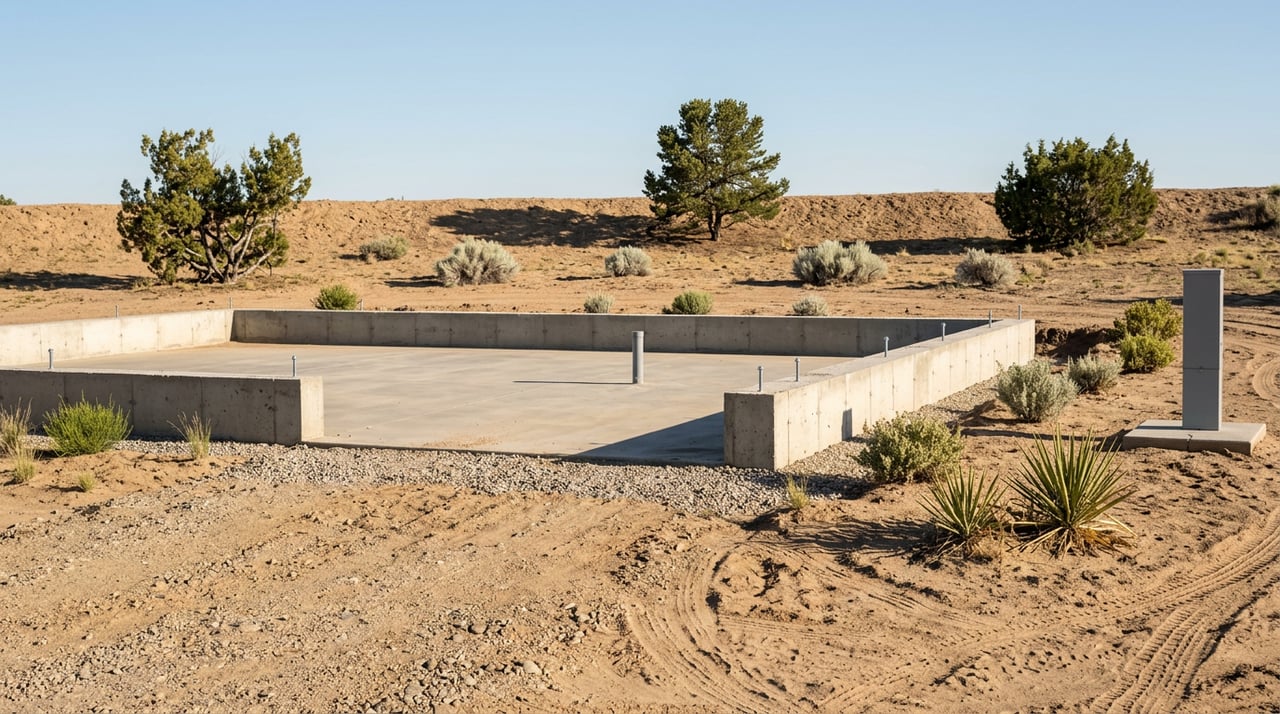
Two 2.5-acre parcels sit off Markle Rd. Same acreage, same underground power stubbed to the property line, same view of the La Sals. One lists at $55,000. A one-acre lot fifteen minutes away lists at a price that implies more than double per acre. The mountain isn't doing that work. The water is.
If you are comparing La Sal land right now, the number that matters is not price per acre. It is who has already paid for the water right, and who has not.
The water right is the asset. The well is the invoice.
Most out-of-area buyers assume the sequence is: buy the land, hire a driller, get water. In Utah it runs the other way. A valid water right has to be in place before a well can be drilled, and the Utah Division of Water Rights issues a document called a Start Card that functions as the actual permit to construct. Licensing sits under Utah Code §73-3-25, and every driller working the hole has to be state-licensed.
There used to be a workaround. Hand-drilled or driven wells under 30 feet fell outside the state engineer's regulation, which meant a landowner with a shallow water table could bypass the licensed-driller step. That exemption was removed by statute effective May 10, 2022, and the administrative rules at R655-4 caught up on July 22, 2022. Today there is no depth at which an unlicensed hand-put well is legal to construct in Utah.
Which is why the phrase "must drill a well and install septic," repeated across nearly every La Sal listing, is doing more than describing a chore. It is telling you the seller is transferring the water-right problem to you.
Reading the fine print on three La Sal subdivisions
Three of the active platted communities in the La Sal / Old La Sal area sell at price bands that only make sense once you decode what is and isn't included.
| Subdivision | Power | Water | Telecom | What the buyer still owes |
|---|---|---|---|---|
| Legacy Fields | Stubbed to lot | Shared-well interest included | Fiber available | Septic, connection, house |
| Mountain Homes (Old La Sal) | In place | Not drilled; buyer secures | In place | Water right, drill, septic, house |
| Old Airport Subdivision (Old La Sal) | Underground to lot line | Not drilled; buyer secures | Varies | Water right, drill, septic, house |
| Markle Rd 2.5-acre parcels | Underground to lot line | Not drilled; buyer secures | Varies | Water right, drill, septic, house |
Legacy Fields lots carry a shared-well interest and fiber. That is a large piece of the build-out risk retired at closing. The Markle Rd 2.5-acre parcels at $55,000 look cheaper because the buyer is being handed a longer to-do list, not because the ground is worse. Old Airport Subdivision was recorded on the San Juan County plat rolls in March 2024, so it is genuinely new inventory rather than a re-list, which matters when you are trying to comp anything.
What the drilling actually costs, and why the range is so wide
Statewide, drilled residential wells run roughly $5,000 to $15,000, with total finished depths in Utah spanning 60 to 700 feet. Eastern Utah typically falls in the 100 to 500 foot band. That range is not a rounding error. It is the difference between a $6,500 project and a $14,000 project on adjacent lots.
The realistic timeline from planning to potable water is two to four months. Water-right permit processing alone runs four to eight weeks. Drilling itself takes two to five days. Pump installation, electrical hookup, and bacterial testing add another one to two weeks. If a buyer is trying to be in the ground by summer, the water-right application typically has to be filed by late winter.
A working budget for a La Sal build lot with no existing water infrastructure, before any house construction, looks something like this:
- Water right acquisition or transfer, including state application fees on Utah's flow-and-volume schedule
- Drilled well, $5,000 to $15,000, with real risk of the upper end in eastern Utah geology
- Septic design and install, permitted through the county
- Power service drop from the pedestal or transformer at the lot line to the structure
- Two to four months of carrying costs before a foundation is legal to pour
That is the stack that turns a $55,000 parcel into a $90,000 to $110,000 ready-to-build site, and it is why the Legacy Fields per-acre premium is not a premium at all once you finish the arithmetic.
The proof deadline nobody warns you about
A four-acre parcel currently on the La Sal market carries a water-right application, WRN 05-4001, with a proof-of-beneficial-use deadline of September 30, 2026. That single line in the listing description is the most important sentence a buyer will read on that property.
Water rights in Utah run on beneficial use. If proof isn't filed by the deadline, the state engineer can lapse the application, and the right the buyer thought they were acquiring evaporates on a calendar date the seller already knew about.
A close in August 2026 on that parcel gives a buyer weeks, not months, to demonstrate beneficial use or to file for an extension. That is a transaction-specific detail that never appears in a generic land guide, and it is exactly the kind of thing that turns a straightforward closing into a scramble. Any offer written on a La Sal parcel where the water right is still an application rather than a perfected right should carry contingency language tied to the proof date on the application itself.
What the June 2026 market is telling patient buyers
La Sal is not a hurry market. As of June 2026, the median list price sat at $442,000, roughly $295 per square foot, with median days on market at 222. Days on market fell about 15 percent year over year, and price per square foot slipped about 4 percent over the same window. Translation: inventory is moving faster than it was, but the pricing power is with the buyer.
Sellers know it, which is why seller financing has resurfaced on several Old La Sal parcels at 15 percent down, six percent interest, up to a fifteen-year term. Those terms tell you two things. First, the seller is willing to carry paper because bank financing on raw land in a remote San Juan County location is friction. Second, the buyer who can pay cash or bring bank financing has real negotiating leverage on price, on closing timeline, and on who eats the water-right and septic-permit costs.
The order of operations that actually works
For a buyer who has decided La Sal is the right community and now needs the parcel decision to pencil, the sequence is roughly:
- Pull the plat and confirm the subdivision. San Juan County publishes recorded plats for Blankenagle, Old Airport, and the Stewart amendments online.
- Ask the listing side, in writing, for the status of any water right attached to the parcel. Perfected? Approved application? Pending? Include the WRN.
- If the parcel sits in a shared-well community, request the shared-well agreement before earnest money goes hard.
- Get a driller's rough quote based on nearest logged wells. The Utah Division of Water Rights well-log database is searchable by section and radius, and neighboring well logs are the single best predictor of what the buyer's hole will look like.
- Confirm septic feasibility with the county before design dollars are spent.
- Only then run the total-cost-to-buildable number against the listing price. That is the number to negotiate against.
Buyers who run that sequence stop treating La Sal parcels as a per-acre comparison and start treating them as an infrastructure spread. The parcel with the shared well and fiber is often the better deal even when the sticker looks higher. The parcel with the September 30, 2026 proof deadline is a good deal only if the closing calendar accounts for it.
Frequently asked questions
Can I put in a hand-dug or driven well under 30 feet without a licensed driller? No. That exemption was removed in May 2022, and the state now regulates well construction at any depth under R655-4.
Does the water right transfer automatically with the deed? Not always. Water rights in Utah are separate property interests. Some La Sal listings convey a shared-well interest with the deed, some convey a perfected right, and some convey only an application in process. Read the title work carefully and confirm with the Division of Water Rights.
How long does it realistically take from closing to habitable structure on raw La Sal land? Assume four to six months minimum before a foundation is legal to pour, if the water right has to be acquired or perfected. Building on top of that is a separate timeline with San Juan County.
Is a shared-well interest a better deal than drilling my own? Sometimes. It retires the water-right and drilling risk at closing, but it also comes with a shared-well agreement that governs maintenance costs, usage limits, and dispute resolution. It is a document to read before, not after, going under contract.
La Sal parcels reward buyers who model the full infrastructure stack instead of the sticker. That work is easier with someone who has already read the plats, the water-right files, and the shared-well agreements on the properties in this market. Blake Walker Group works these deals from Moab and knows which La Sal listings carry water rights that are truly transfer-ready and which ones come with a countdown clock. Get a free home valuation, or reach out before you write an offer on a raw parcel and we will walk the numbers with you.